
Phonemic Awareness
Before a child can match letters to sounds, they have to hear the individual sounds inside spoken words. That skill is called phonemic awareness, and it's the foundation everything else is built on. It's done entirely by ear, with no letters in sight.
Watch: the Phonemic Awareness Drill in action, then try it with your child.
Why it comes first
Reading is a code: letters stand for sounds. But a child can't crack that code if they can't yet tell the sounds apart in the first place. Strengthening phonemic awareness, even a few minutes inside every session, makes everything that follows (the Sound Cards, blending, spelling) click into place faster.
The four moves to practice
Keep it by ear
Phonemic awareness happens with your eyes closed. No flashcards, no letters, just sounds. Five minutes in the car or at bath time is perfect.
Blend three sounds
Pick five simple words (cat, sun, map, dog, fish). Say each one sound by sound and have your child blend it. Note which were easy and which were tricky.
The Sound Cards
Once your child can hear the sounds, the Sound Cards connect each sound to the letter (or letters) that spell it. They're the workhorse of the whole curriculum: quick daily drills that build instant, automatic letter-sound recall.
Watch: how to introduce and drill a Sound Card.
How the drill works
Show the card, your child says the sound (not the letter name). Keep the pace brisk and the deck short. Review known cards daily and add new ones only when the old ones are automatic. Three minutes a day beats twenty minutes once a week.
In the Teacher Guide this is called the Quick Drill Decoding. You'll see that name at the top of every lesson day, right after the Short Vowel Posters. Same drill, official name.
Try it: the Sound Cards
Tap a card to flip it and hear the sound. This is the same deck you'll teach with. Use it for review on the go.
Your roadmap: the Scope & Sequence
The Scope & Sequence is the curriculum's master map, one chart showing every lesson in order: which sounds get introduced when, which syllable type is being taught, and which decodable story goes with it. It exists for one reason: order is the whole trick. Sounds build from simple to complex, so every word your child is asked to read uses only sounds they've already been taught. Follow the order, and there's nothing to guess, ever.
How to use it, practically:
- Find your row. Whatever lesson you're on, that row tells you exactly which sound cards belong in this week's deck.
- Everything above your row is fair game for review, word lists, and stories. Everything below it isn't yet. Don't jump ahead, even on a good week.
- Peek one row down on Sunday night. Thirty seconds of preview and Monday's "new concept" is never a surprise to you.
| Lesson | Syllable type | New concepts | Examples | Decodable stories |
|---|---|---|---|---|
| 1 | Syllable | Vowels & consonants What is a syllable? Short a | mat, map, sat, can, tan | The Fat Cat Can Tap The Fat Rat's Hat The Band |
| 2 | Closed Syllable | Digraphs vs blends Closed syllable Short o | sh/th/ch vs. st/tr/nd · top, mop, pot · bath, duck, crash | The Slop Pot A Jog in the Bog Fran at the Shop |
| 3 | Closed Syllable | Welded sounds Double letter rule Short i | am, all, an, alk · Lizz will miss Muff · fall, ball, walk, talk | Ball Toss The Glass that Spills Jim's Big Job |
| 4 | Closed Syllable | Closed syllable exceptions Sounds of s (/s/, /z/, /iz/) Short e | old, ild, olt, ind, ost · tops, bugs, riches · mold, child, colt, kind | Beck and the Fish Jen and the Co Hens and Chicks Peck |
| 5 | Closed Syllable | Welded sounds /ch/ sound ('ch', 'tch') Short u | ong, ang, ung, ing · itch, switch, match · cut, hut, rug | Bob the Pug The Bus Trip Jam on a Bun |
| 6 | Closed Syllable | Welded sounds 'y' as a vowel Sounds of 'g' & 'c' | onk, ank, unk, ink · gym, crypt, hymn · gem, gin, cert, cinch | The Stink The Rink Hank's Locks |
| 7 | Closed Syllable | Two-syllable words Scooping 'ct' blend | catnip, dentist, napkin · insect, collect, fact, object | The Kitten Jam Sandwich Jeff and the Dentist |
| 8 | Open Syllable | Multi-syllable words Schwa | penmanship, fantastic, basketball · animal, camel, across | The Red Rock Hiccups Talents |
| 9 | Open Syllable | Open syllable Long vowel sounds 'y' as a vowel in open syllables | la, ba, me, be, hi, no, so · sky, fly, try, my, by, fry | The Flu The Sunset The Scratch |
| 10 | Open Syllable | Multi-syllable words Scooping | ago, human, protect, music, bacon, unit, solo, rodeo | The Plant Patch The Pilot The Menu |
| 11 | Open Syllable | 'y' says /e/ in multi-syllable words | happy, funny, jelly, penny, lazy, lily, bunny, candy, taffy | The Stinky Socks The Candy Shop Brenda's Job |
| 12 | Review | Review of Level 1 | Everything above, now automatic | The Rip The Rodeo The Plant Box |
The gold edge marks where Module 2 leaves you: ready for Lesson 1. Want it on paper? Print the chart from the Resource Hub.
Inside the workbook
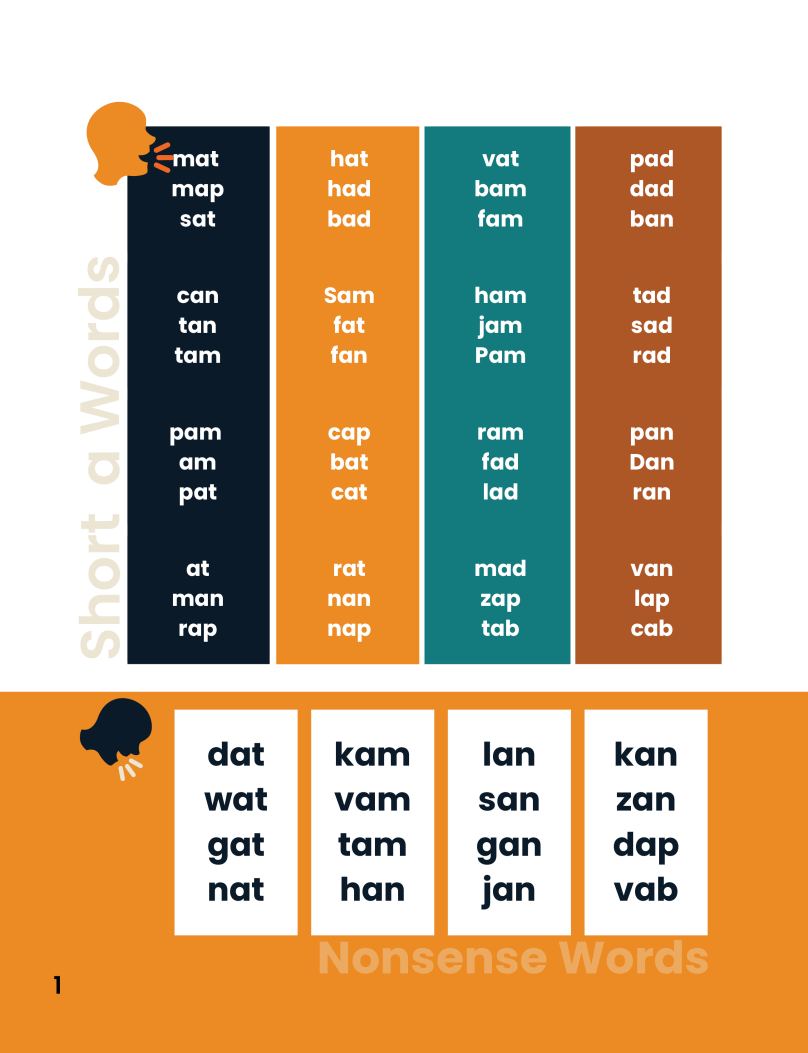
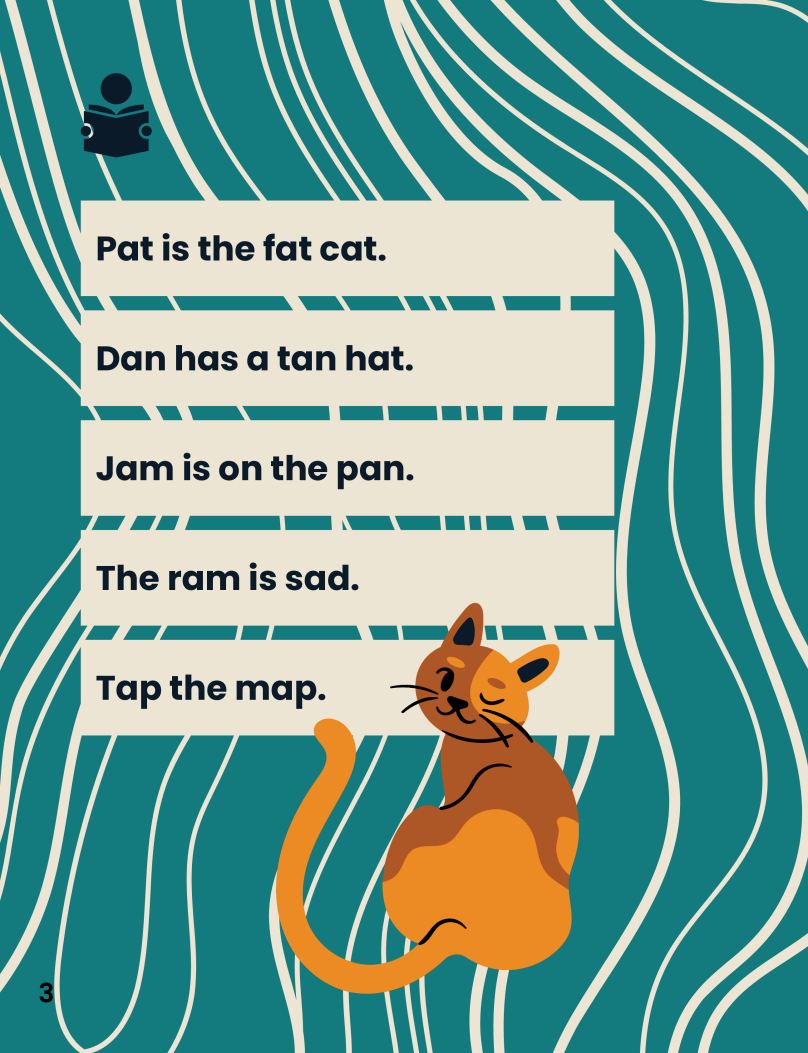
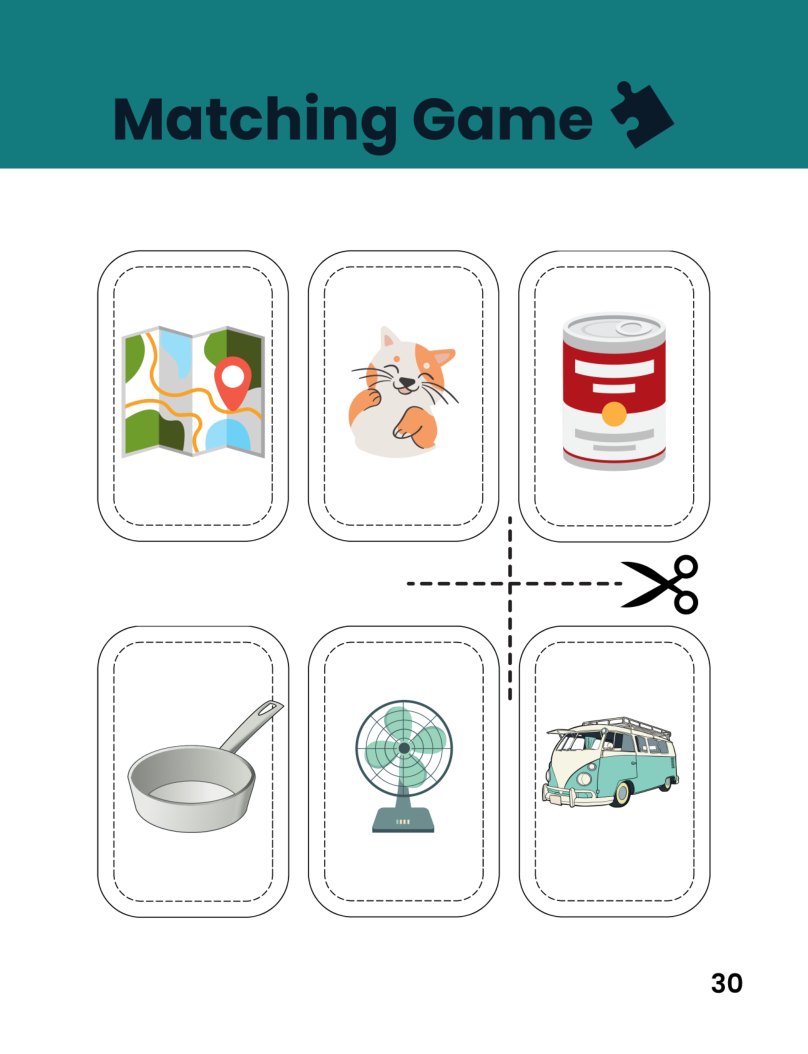
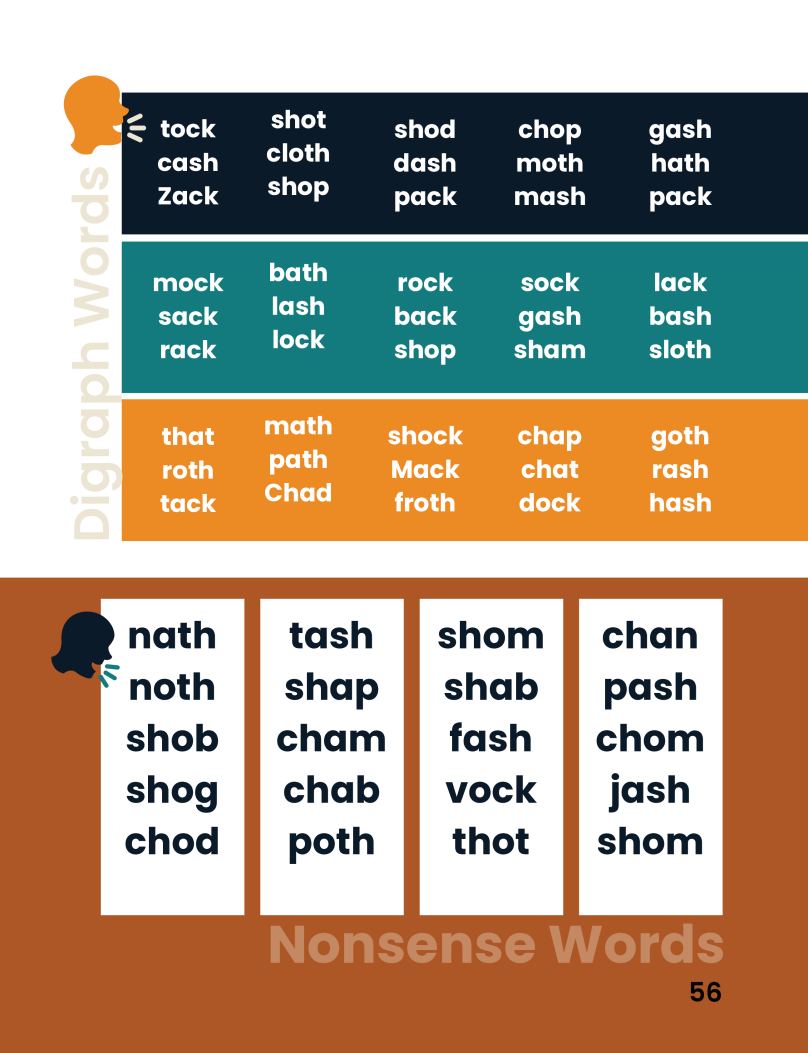
This is what your child's pages actually look like: real spreads from Level 1, Workbook 1. Word columns end with nonsense words on purpose, sentences use only taught sounds, and the games are built to be cut out and played.
Decodable Word Generator
Generate practice that uses only the sounds your child has learned so far, the heart of structured literacy.
Run a three-minute deck
Pick 5–8 cards your child already knows plus one new one. Show each card, they say the sound, keep it brisk: three minutes, then stop even if it's going well. Which cards were automatic, and which needed a beat to recall?
Blending & Scooping
Now we put it together: turning a row of sounds into a smoothly-read word. “Scooping” is the multisensory technique that stops choppy, letter-by-letter reading and builds real fluency.
The scooping technique
As your child reads, they draw a small “scoop” under each chunk of the word with a finger or pencil, sweeping the sounds together as they say them. The motion physically connects the sounds into a blend.
Left: the scooping symbols. Right: the scooping drill.
Backward scooping & the tile mat
Once forward scooping is smooth, “backward scooping” builds accuracy by checking the word from the end. And the tile mat lets your child build and break words with their hands: finding a sound, then spelling words tile by tile. The Teacher Guide calls this hands-on spelling side the Quick Drill Encoding. Decoding is sounds to words, encoding is words back to sounds.
More demos and the whole technique library live in the Video Library.
Decodable text only
Have your child scoop words made only of sounds they've been taught. Success builds confidence. Guessing builds bad habits.
Scoop five words
Write five decodable words. Have your child scoop under each one as they read it. Did scooping make the blend smoother?
Kitchen Table Moments
You know the techniques. This is about the moments the techniques don't cover: the guess, the tears, the flat refusal at 7pm. Each card is a real moment from real practice sessions. Think about what you'd do, then open the card for exactly what to say next.
Sounding out turns into guessing
Your child sounds out c-a-t slowly and carefully… then looks up and says “kitten.”
“Those sounds were perfect: /c/, /a/, /t/. Now scoop them together with your finger and say them fast.”
You praised the part that was right (the decoding) and redirected to the blend, without the word “no.” Guessing from the first letter is the habit we're replacing; every redirect back to the sounds weakens it.
“I hate reading. I'm stupid.”
Two words in, your child pushes the page away. Eyes are wet. It's clearly not about tonight's words anymore.
“This is hard, and you are not stupid. Your brain learns reading a different way, and we have the way. One word together, then we're done for tonight.”
You named the feeling, corrected the self-talk with the truth from Module 1, and shrank the task to guarantee an ending on success. Protecting how your child feels about reading matters more than finishing tonight's list.
“No. I'm not doing it.”
Practice time. Arms crossed. Total shutdown before you've even opened the workbook.
“Okay, you pick: Sound Cards first or tile mat first? You're the boss of the order.”
A child who fails at school all day is out of control all day. Choice hands back a piece of control without negotiating whether practice happens, only how. Keep the choices small and both acceptable to you.
Rushing through, skipping words
Your child is flying down the page, mumbling through half the words, clearly trying to get it over with.
“Whoa, speedy! Let's make your finger do the work. Scoop this one for me, nice and smooth.”
Rushing usually means the task feels endless. The scoop physically slows the pace without a lecture, and one well-read word beats ten mumbled ones. If the rushing continues, the session is probably too long. Shorten it.
They knew it yesterday, but it's gone today
The /sh/ card was automatic all week. Today your child stares at it like they've never seen it before. You feel your own frustration rising.
“My turn. Watch me. /sh/… ship. Now you.” (Then move on. No sigh, no “we JUST did this.”)
Skills coming and going is dyslexia working exactly as described: automaticity takes far more repetitions than it does for other kids. Modeling the answer keeps the drill moving and keeps the card from becoming a battleground. It will stick; the reps just aren't done yet.
“Why is it so easy for her?”
Your child watches a younger sibling breeze through a book and asks why reading is so easy for everyone else.
“Reading is harder for your brain. That's real, and it's not your fault. And your brain does things hers doesn't. Remember the fort design? That came from the same brain. We're doing this practice because it works, and you're getting stronger every week.”
Honesty beats reassurance. Kids know when reading is harder for them, and denying it costs you trust. Pairing the truth with a specific strength (not a vague “you're special”) and with evidence of progress gives them a story about themselves they can actually believe.
“That's not a real word!”
The word list says vab. Your child stops cold: “Vab isn't a word. This is dumb.”
“You're right. It's a pretend word, and that's the point. Anyone can memorize real words. Only a real reader can read a word that doesn't exist. Show me.”
Nonsense words are in the workbook on purpose: they can't be guessed or memorized, so they prove your child is decoding. Framing them as the harder, more impressive skill turns an objection into a flex.
The lesson falls apart at minute 35
Monday's full lesson is going long. You're only at sentence reading, your child is fading, and dinner needs to start.
“Two sentences, then story time.” (Cut the middle, keep the story. Then tomorrow, set a timer for each activity and move on when it rings, finished or not.)
The Teacher Guide builds this in: every activity has a 2–10 minute window, and you're allowed to cover less inside it: fewer cards, one word column, a few sentences. The one block it says never to skip is Read a Story & Comprehension. Protect that, flex everything else.
Writing time turns into a slump
Halfway through writing words and sentences, your child's letters are getting huge and wobbly, and their head is on the table.
“Shake out your hand. Wiggle it like jelly. One more sentence, your best one, and we're done writing today.”
Writing is the longest block of the lesson (8–10 minutes), and handwriting fatigue is physical, not attitude. The curriculum expects you to start small (3–4 words, 2–3 sentences) and grow from there. One good sentence beats three miserable ones.
It actually went well tonight
Your child scooped a whole sentence without help for the first time. They're playing it cool, but you saw the little smile.
“Did you notice what you just did? You read that whole sentence yourself, every word. That was you.”
Name the win precisely and give your child ownership of it (“that was you,” not “good job”). Kids with dyslexia collect evidence they're bad at reading all day; your job is to make the counter-evidence impossible to miss.
The pattern behind every card
Notice the shape: name what's true, shrink or redirect the task, end on success. You don't need to memorize ten scripts. You need that one pattern. The words will become your own.
Pick your moment
Which of these ten moments happens most at your table? Write down the “say this” line in your own words, so it's ready before you need it.
Ready to teach the sounds?
Totally optional. Your progress doesn't depend on it. Five quick phonics questions with instant feedback, if you want them.