
If your child is struggling to read and you suspect dyslexia, the most useful thing to know is that dyslexia is highly treatable with the right instruction. This guide answers the questions parents ask most often — what dyslexia actually is, what the early signs look like, when to test, whether it runs in families, and what you can do tonight to help. None of this requires a teaching degree, just clear information and a steady plan.
What is dyslexia, exactly?
Dyslexia is a specific learning difference that makes it hard to connect the sounds of spoken language to the letters and patterns that represent them in print. It is not a problem with vision, and it has nothing to do with how smart a child is. Many children with dyslexia are bright, curious, and verbally strong — they simply struggle with the part of reading that asks them to decode words sound by sound.
The core difficulty lives in phonological processing: hearing, holding, and manipulating the individual sounds (phonemes) inside words. When that system works smoothly, a child can blend c-a-t into “cat” almost without thinking. When it does not, reading stays slow and effortful long after peers have moved on. Because the rest of the brain is working hard to compensate, children with dyslexia often arrive at the right answer eventually — just with far more fatigue. For a fuller picture, see Defining Dyslexia and our overview, A Little About Dyslexia.
What are the early signs of dyslexia?
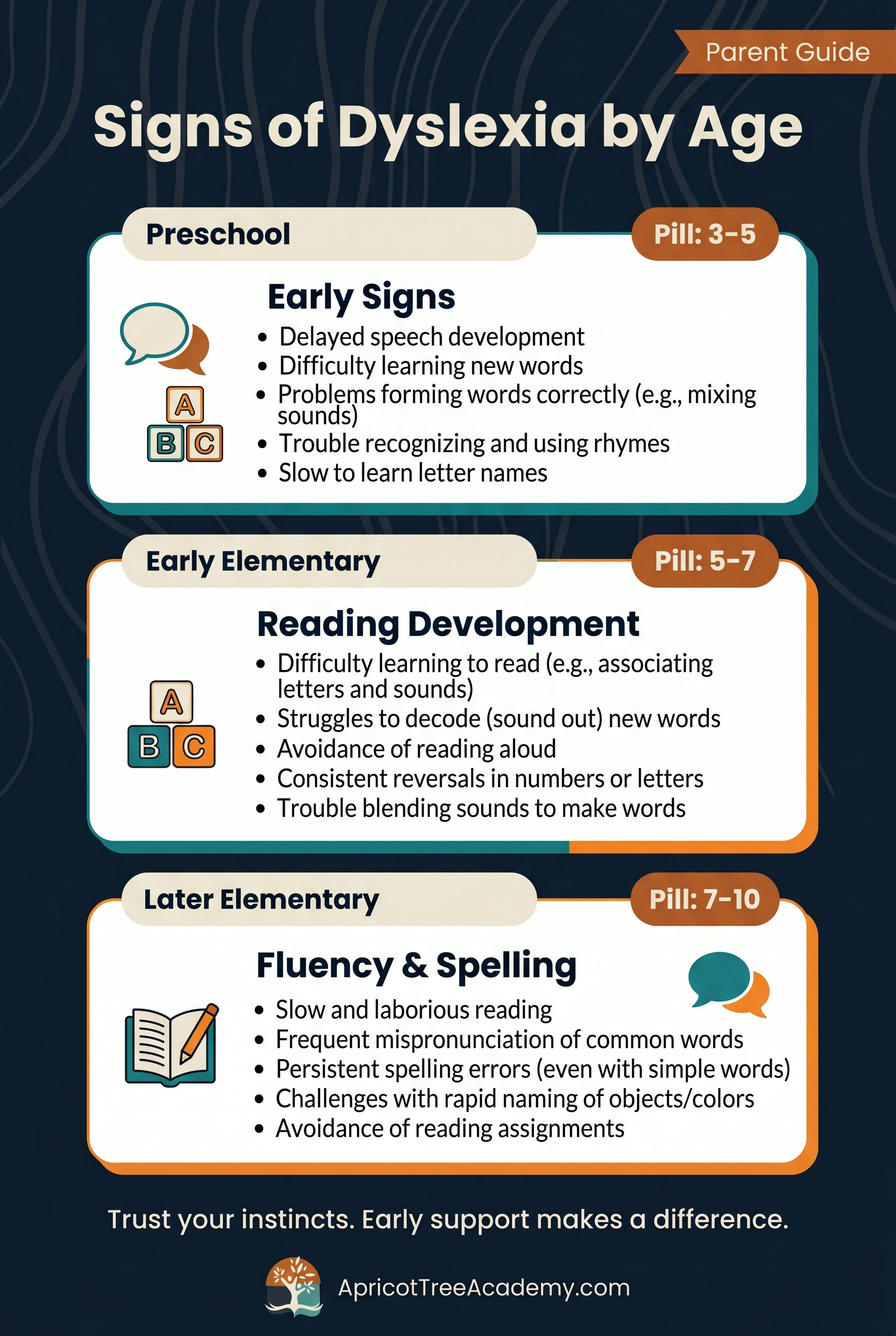
Signs show up before, during, and after a child starts formal reading. No single one is a diagnosis, but a cluster of them is worth paying attention to. Common early indicators include:
- Trouble learning and remembering the names and sounds of letters
- Difficulty rhyming, clapping syllables, or hearing the separate sounds in a word
- Confusing similar-looking letters or guessing at words from the first letter
- Slow, choppy reading that does not get smoother with ordinary practice
- Spelling the same word several different ways on the same page
- A noticeable gap between what a child can do out loud and what they can do on paper
- Avoiding reading, calling it “boring,” or melting down at homework time
If several of these sound familiar, you are not imagining it. Our parent’s checklist of signs in children ages 5–10 walks through what to watch for by age, and Early Signs and Steps Towards Diagnosing Dyslexia covers what to do once you start noticing a pattern.
At what age can a child be tested for dyslexia?
A formal diagnosis is usually most reliable around ages 6 to 7, once a child has had real exposure to reading instruction and a clear gap can be measured. That said, you do not have to — and should not — wait that long to act. Screening for risk factors like weak phonological awareness can happen as early as kindergarten, and concerns in a 5-year-old are a reason to start support, not to sit and watch.
The key principle is that intervention should never wait for a label. Many parents are told to “wait and see” while a struggling reader falls further behind, but the science points the other way: the earlier explicit reading help begins, the easier the path. You can request an evaluation through your school or seek a private one. Our guide to dyslexia testing explains the assessment process, who can diagnose, and how to read the report you get back.
Is dyslexia genetic?
Yes, dyslexia tends to run in families. If a parent or sibling has dyslexia, a child is meaningfully more likely to have it too — which is why so many parents recognize their own childhood reading struggles in their child. It reflects inherited differences in how the brain is wired for language processing, not anything a parent did or failed to do.
That family pattern is actually useful information. If dyslexia is in your family tree, you can watch for early signs sooner and start strong literacy practices before frustration sets in. Knowing the cause is biological also helps with the emotional side: this is not the result of laziness, poor parenting, or too much screen time. It is a difference in brain wiring — one that comes with real strengths, which we explore in Strengths of Dyslexia.
Can dyslexia be cured?
Dyslexia is not an illness, so it cannot be “cured” — and it does not need to be. It is a lifelong difference in how the brain processes language. What absolutely can change, dramatically, is a child’s ability to read, spell, and write. With the right instruction, children with dyslexia learn to read well and go on to thrive in school and careers of every kind.
Be cautious of any product or program promising a quick fix, a special font, or colored overlays as a cure. The approach with the strongest evidence is structured literacy — explicit, systematic, cumulative teaching of how sounds map to print — often delivered through an Orton-Gillingham approach. This is the foundation of the Dyslexia Intervention Curriculum, and it is rooted in the Science of Reading. The goal is not to erase dyslexia but to build the reading skills around it.
How can I help my dyslexic child at home?
You can do a great deal at home, even with no teaching background. The most powerful thing is consistent, short, structured practice with the sounds of language. A few high-impact habits:
- Play with sounds. Rhyming games, clapping syllables, and “what sound does this word start with?” build the phonemic awareness reading depends on.
- Keep practice short and daily. Ten to fifteen focused minutes beats an hour of struggle. Consistency builds the brain pathways.
- Make it multisensory. Trace letters in sand, build words with tiles, say sounds out loud while writing them. Engaging more senses helps the learning stick.
- Read aloud together. Audiobooks and shared reading keep stories and vocabulary flowing while decoding skills catch up.
- Protect their confidence. Praise effort, separate reading struggle from self-worth, and celebrate progress.
If you want a structured plan, our step-by-step guide on how to teach a dyslexic child to read at home lays out the sequence, and you can follow along with the companion workbook on Amazon. The emotional side matters just as much as the academic one, so guarding your child’s sense of being capable is part of the work, not a distraction from it.
How do I get support from my child’s school?
Schools can provide meaningful support, but you usually have to ask for it clearly and in writing. Start by putting your concern in an email to the teacher and requesting an evaluation for a possible learning disability. A written request typically starts the clock on the formal process and creates a record.
From there, your child may qualify for an IEP or a 504 plan that spells out accommodations — things like extra time, audiobooks, reduced copying, or specialized reading instruction. Knowing what to ask for makes these meetings far less intimidating. Our guide on collaborating with schools covers how to build a working partnership with teachers, and if you hit a wall, When the School Refuses Help explains your options. You are your child’s most important advocate, and a calm, informed, persistent parent changes outcomes.
Frequently Asked Questions
Is dyslexia a sign of low intelligence?
No. Dyslexia is unrelated to intelligence. Many children with dyslexia are bright and verbally strong; they simply struggle with the specific skill of connecting sounds to printed letters.
What is the best treatment for dyslexia?
The most evidence-based approach is structured literacy — explicit, systematic, multisensory instruction in how sounds map to print, such as an Orton-Gillingham approach. It is the foundation of effective dyslexia intervention.
Will my child grow out of dyslexia?
No. Dyslexia is a lifelong difference in how the brain processes language. Children do not grow out of it, but with the right instruction they can become strong, confident readers.
Can a parent help a dyslexic child without teaching experience?
Yes. Short, consistent, multisensory practice with letter sounds — plus reading aloud together and protecting your child's confidence — makes a real difference, and structured at-home programs guide you step by step.
Should I wait to get my child tested for dyslexia?
Don't wait to act. Formal diagnosis is often most reliable around ages 6 to 7, but you can begin support as soon as you notice signs. Early intervention makes reading easier to learn.