
The early signs of dyslexia show up as a gap between how capable your child clearly is and how much they struggle with reading and spelling. Dyslexia doesn’t affect intelligence, so a child can be verbal, curious, and creative while still finding it nearly impossible to connect letters to sounds. Recognizing that pattern early is the first and most important step toward getting your child the help they need.
What is dyslexia, exactly?
Dyslexia is a common, brain-based learning difference that mainly affects accurate and fluent word reading and spelling. It shows up as difficulty with phonological awareness (hearing and manipulating the sounds in words), verbal memory, and verbal processing speed. Importantly, dyslexia does not affect intelligence. Children with dyslexia are often deeply creative, articulate, and see the world in their own unique way — the challenge sits specifically with decoding written language, not with how bright they are.
That mismatch is exactly why dyslexia is so easy to miss. A child who tells elaborate stories and asks big questions doesn’t look like a child who is struggling, so the reading difficulty gets explained away as a phase. Understanding what dyslexia actually is helps you trust your instincts when something feels off.
What are the early signs of dyslexia?
In my own journey as a parent, the first signs were subtle but became more noticeable over time. The most common early signs include:
- Difficulty learning to read. An eager, willing child who still can’t reliably match letters to their sounds.
- Problems with word retrieval. Struggling to find the right word in conversation, or to recall simple words while reading.
- Reversing letters. Confusing letters like ‘b’ and ‘d’ beyond the age when this is developmentally typical.
- Poor spelling and writing. Spelling that doesn’t improve no matter how much they practice, and writing tasks that feel arduous and full of errors.
You might also notice your child avoiding reading altogether, taking an unusually long time over simple worksheets, or coming home drained and frustrated after school. Some children memorize a handful of words so well that they appear to be reading, only to stumble badly the moment a new or longer word appears. Difficulty learning the alphabet, rhyming, or remembering the days of the week and other sequences can show up earlier still. None of these in isolation proves anything — but together they form a picture worth paying attention to.
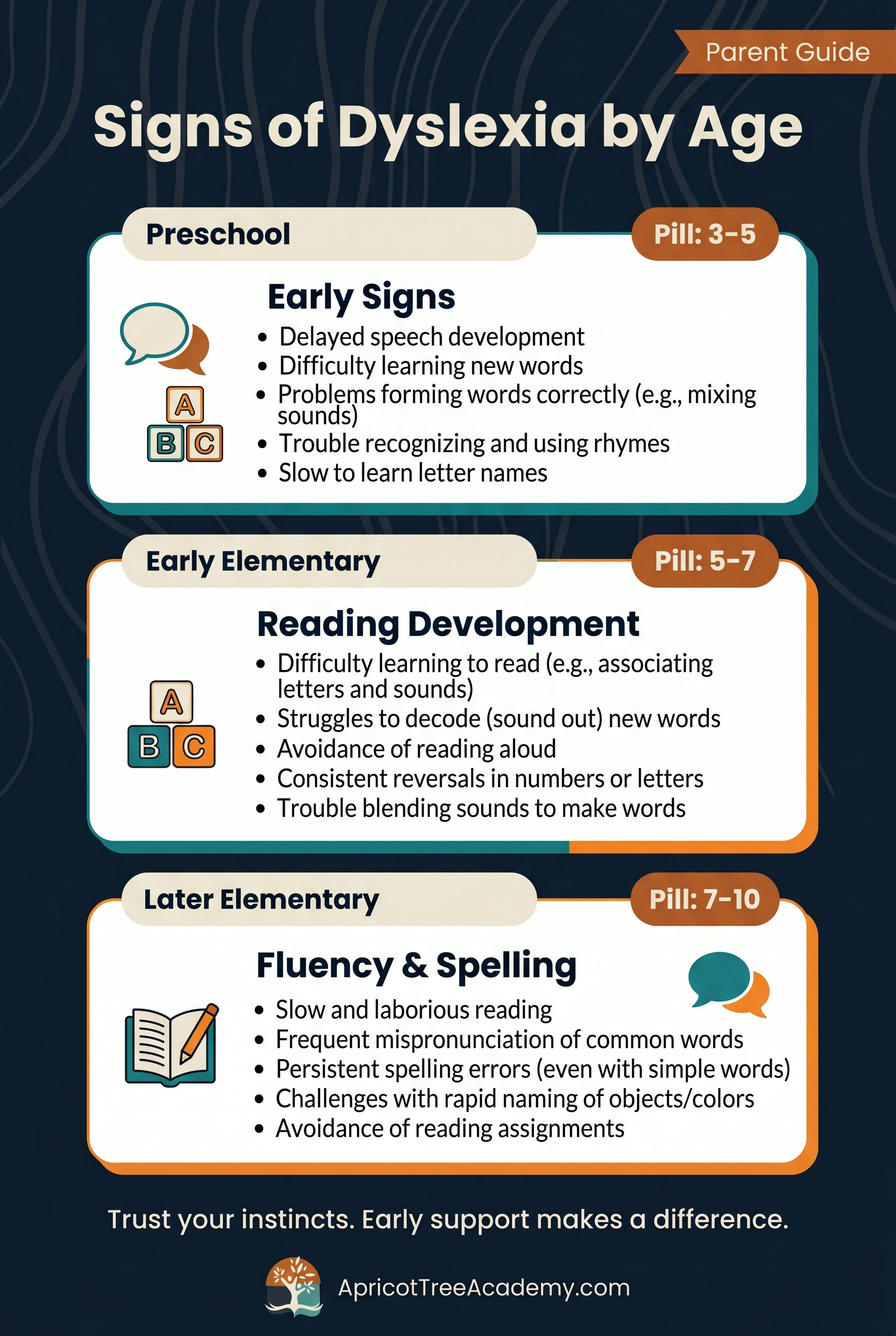
One sign on its own usually isn’t cause for alarm — plenty of young children reverse letters for a while. It’s the pattern, the persistence, and the gap between effort and progress that matter. For a fuller breakdown by age, our parent’s checklist of dyslexia signs in children ages 5–10 walks through what to look for year by year. The key takeaway: don’t dismiss these difficulties as ordinary developmental delays.
What does the journey to diagnosis look like?
For me, it began with conversations with my child’s teacher, who at first thought the struggles were just a phase. But as an educator myself, I knew something wasn’t right. That instinct led me to dig into the research on reading difficulties, where I found a wealth of information on dyslexia — and realized, surprisingly, that none of my formal education had prepared me for this.
Armed with that knowledge, I went back to the school for support and met resistance instead. I heard “Let’s wait and see,” and worse, that “dyslexia is just an excuse for lazy learners.” Those comments were wrong, and they only sharpened my determination to advocate for my child. If you hear something similar, take it as a sign to push forward, not to back down. Trusting what you see at home is not overreacting — it’s parenting.
What are the first steps for parents?
If you suspect your child has dyslexia, here are practical steps you can take right now:
- Get informed. Read up on dyslexia from reputable sources like the International Dyslexia Association so you can recognize the signs and speak with confidence.
- Talk to your child’s teacher. Share your concerns directly and ask what they’re observing in the classroom.
- Seek a professional evaluation. This can come from a school psychologist or an independent educational psychologist who specializes in learning differences. Our guide to dyslexia testing explains what an evaluation involves and who can provide one.
- Advocate. Be ready to push for the support your child needs, even if it means challenging the school’s initial assessments or conclusions.
As you go through this process, keep a simple record of what you’re seeing at home: the words your child reverses, the spelling errors that keep coming back, the homework that ends in tears. Concrete examples make your concerns harder to wave away and give an evaluator useful information to work with. It also helps to bring along any reading samples or report-card comments that show the pattern over time. The more specific you can be, the faster you can move from “is something wrong?” to “here’s what we’re going to do about it.”
If your child does receive a diagnosis, that’s not the end of the road — it’s the start of a clear plan. Our piece on what to do first after a dyslexia diagnosis lays out the next moves so you’re not left wondering what comes next.
Why does catching it early matter so much?
Understanding dyslexia early can change a child’s academic and personal life. It did for mine — once she was diagnosed, she received the targeted support she needed, and we saw improvement not just in reading and writing, but in self-esteem and overall happiness. The earlier a child gets explicit, systematic help, the more those gains compound.
The support that works is structured and evidence-based: explicit, multisensory phonics taught in a clear sequence, grounded in the Science of Reading and approaches like Orton-Gillingham and structured literacy. Our Dyslexia Intervention Curriculum is built on exactly this model and designed for parents to teach at home — no special training required. You can begin with the Level One, Month One materials, including the workbook on Amazon, and start helping your child today.
The path to helping a child with dyslexia starts with recognition and understanding. You don’t need to have all the answers up front. You are your child’s best advocate and most significant support — and that, more than anything, is what makes the difference.
Frequently Asked Questions
What is the earliest sign of dyslexia in young children?
One of the earliest signs is difficulty matching letters to their sounds despite being eager to learn. You may also notice trouble finding the right words in conversation, letter reversals past the typical age, and spelling that doesn't improve with practice.
Does dyslexia mean my child isn't intelligent?
No. Dyslexia does not affect intelligence. It specifically affects accurate, fluent word reading and spelling, and many children with dyslexia are highly creative, articulate, and curious.
Should I wait and see, or act on my concerns now?
Act now. "Wait and see" can delay the support your child needs during the years when intervention is most effective. If you see a persistent gap between your child's ability and their reading progress, pursue answers.
Who can formally evaluate my child for dyslexia?
A school psychologist or an independent educational psychologist who specializes in learning differences can conduct a formal evaluation. You can request one through your child's school or arrange a private assessment.
What kind of help works best for a child with dyslexia?
Explicit, systematic, multisensory reading instruction grounded in the Science of Reading — such as Orton-Gillingham and structured literacy approaches. This kind of intervention builds the specific skills dyslexic readers need, and the earlier it starts, the better.