

The mindset that makes home teaching work
Before tactics, mindset. The parents who succeed at teaching a dyslexic child to read share three traits.
They take a long view. Reading is built over months, not days. Setting your sights on six months instead of six weeks changes how you respond to a hard session.
They prioritize consistency over intensity. Twenty minutes a day, six days a week, beats two-hour weekend marathons every time. Brain connections form through frequent reinforcement, not occasional cramming.
They lower their voice when their child is struggling. Stress shrinks working memory. The child who's failing right now needs less pressure, not more.
The daily 20-minute routine
The structure below works for almost any age between 5 and 10. Adjust pace, not structure.
0:00–3:00 — Warm-up
Quick review of previously learned letter sounds or blends, ideally with a fun multisensory hook. Letter tiles, finger-tapping, hopscotch sounds — anything tactile.
3:00–8:00 — New skill
Introduce one new letter, sound, or pattern. Say it, show it, trace it, write it. Don't move on until your child can produce the sound independently three times in a row.
8:00–13:00 — Word work
Read words that use the new skill (and only skills already taught). Build words with tiles. Spell words by sound.
13:00–18:00 — Read a decodable text
Short passages using only skills your child has been taught. This is where it all clicks. Your child reads for the first time using the new skill.
18:00–20:00 — Wrap up on a win
Quick review of one thing they nailed today. End every session with a positive close.
The skill sequence in order
This is the sequence used in structured-literacy programs, including ours. Don't skip ahead.
- Phonemic awareness — Hearing and manipulating individual sounds in words, with no letters involved. This is foundational.
- Letter sounds (consonants and short vowels) — Building the sound-symbol connection one letter at a time.
- Blending CVC words — Reading and spelling simple three-sound words (cat, mom, sit). The first real reading.
- Digraphs (sh, ch, th, wh, ck) — Two letters that make one sound.
- Blends (st, bl, pr, etc.) — Two letters whose sounds are blended together but stay distinct.
- Closed syllables and long vowels — The first real syllable type, then the silent-e pattern and other long-vowel spellings.
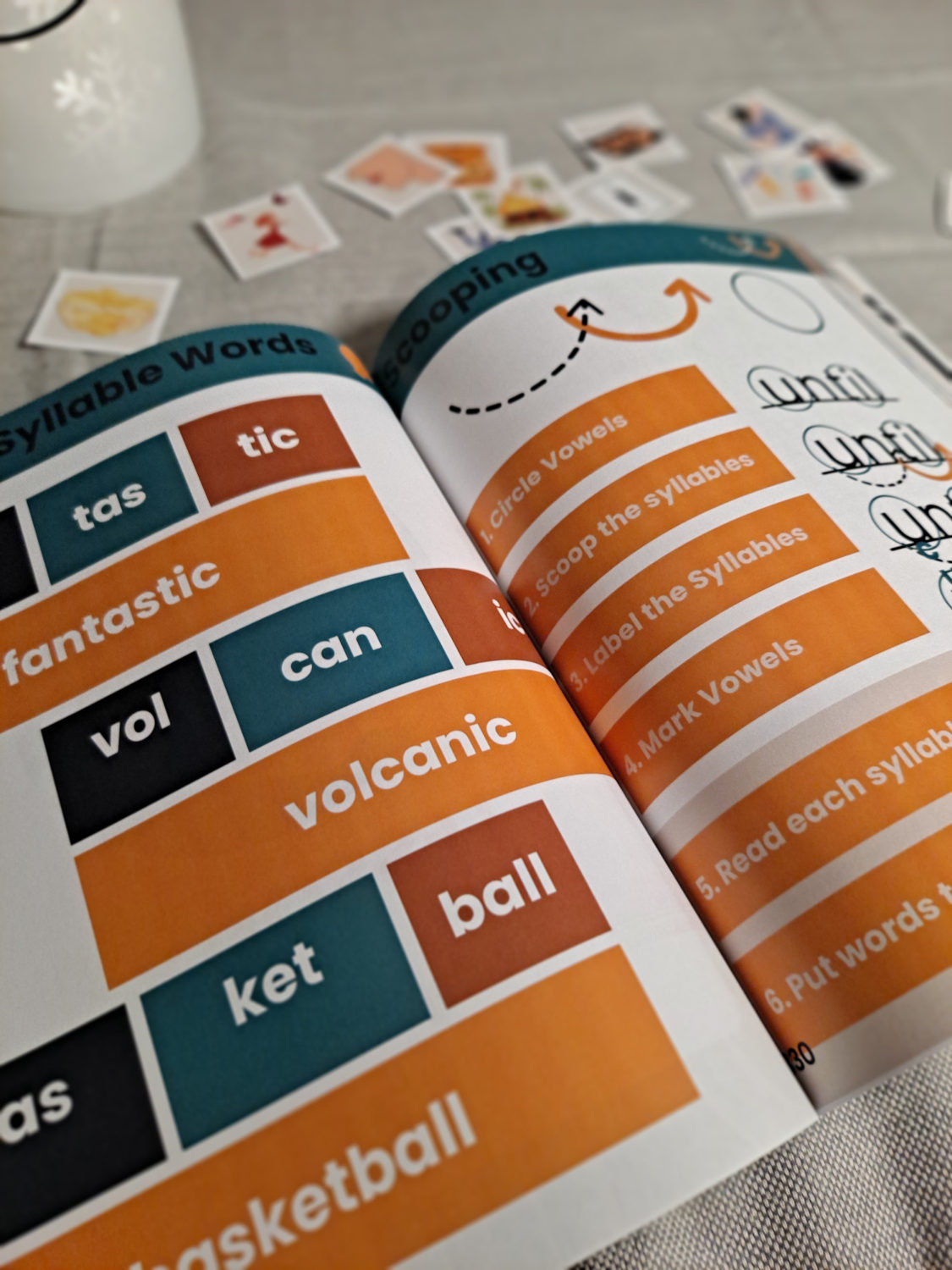
- Multi-syllable words — Breaking longer words into syllables to decode them.
- Morphology — Prefixes, suffixes, and root words. The doorway to vocabulary growth.
How to make every lesson multisensory
For each new sound or pattern, hit four senses:
- Hearing — Say the sound aloud, multiple times.
- Seeing — Show the letter (printed and handwritten).
- Touch — Trace the letter with a finger on the table, on sandpaper, in shaving cream.
- Movement — Tap the sound on fingers, write it large in the air, jump for each sound in a word.
This isn't theater. It works because dyslexic brains need multiple memory pathways for the same connection. One sensory channel may be weak — others fill the gap.
How to know it's working
Three markers of real progress, in order of when you'll see them:
- Automaticity (week 2–6) — Your child reads a previously-learned word without sounding it out. The skill has moved from effortful to automatic.
- Transfer (week 6–12) — Your child applies a skill to a brand-new word they haven't seen before.
- Fluency (month 3+) — Reading sounds smooth and at conversational pace, not labored.
If after 8 weeks of daily structured practice you see no automaticity on previously-taught skills, the program isn't matched to your child's gaps. That's a signal to pause and re-evaluate the program — not your child.
What to do on the hard days
They will happen. Here's the playbook.
- Cut the session short. A bad 15 minutes builds a bad association with reading. End on something they can do.
- Switch to review. Pull out skills they've mastered. Win, then stop.
- Switch the modality. If they hate writing today, do letter tiles. If they hate tiles, sand tray.
- Don't make up the time. Skip the rest. Come back tomorrow.
- Don't argue about reading. Ever. The session is non-negotiable but the volume of frustration is not.
Frequently Asked Questions
How much time per day is enough to teach reading at home?
15–20 minutes a day, six days a week, is enough for most children. The structure and consistency matter more than the duration. More is fine if your child is engaged; less is not.
What if my child refuses to do the lesson?
Refusal almost always tracks to past failure. Shorten the session, drop into review, end on a win. Over time, refusal fades as the experience of success accumulates.
Do I need special materials?
Letter tiles or magnetic letters, lined paper, pencils, index cards, and a small whiteboard cover almost everything. The teacher guide and student workbook of a structured curriculum cover the content.
Should I let my child use audiobooks?
Yes — for content. Audiobooks let dyslexic children keep up with grade-level ideas and stories while reading skills catch up. They don't replace structured-literacy practice; they support it.
How do I know when to move to the next skill?
Mastery means automatic, accurate, and applied. Your child should be able to read the skill in known words and apply it to unknown words without prompting. If they hesitate or guess, they're not ready.