

What dyslexia looks like at school age
Most parents who suspect dyslexia describe the same pattern: their child is clearly bright in conversation, picks up new ideas easily, has a strong vocabulary — but written words are hard. They guess at words from pictures. They confuse small words like "was" and "saw." They spell the same word three different ways in the same paragraph.
That gap — between intellectual ability and reading performance — is the single most reliable early signal. A child who reasons like a 9-year-old but reads like a 6-year-old is sending you information.
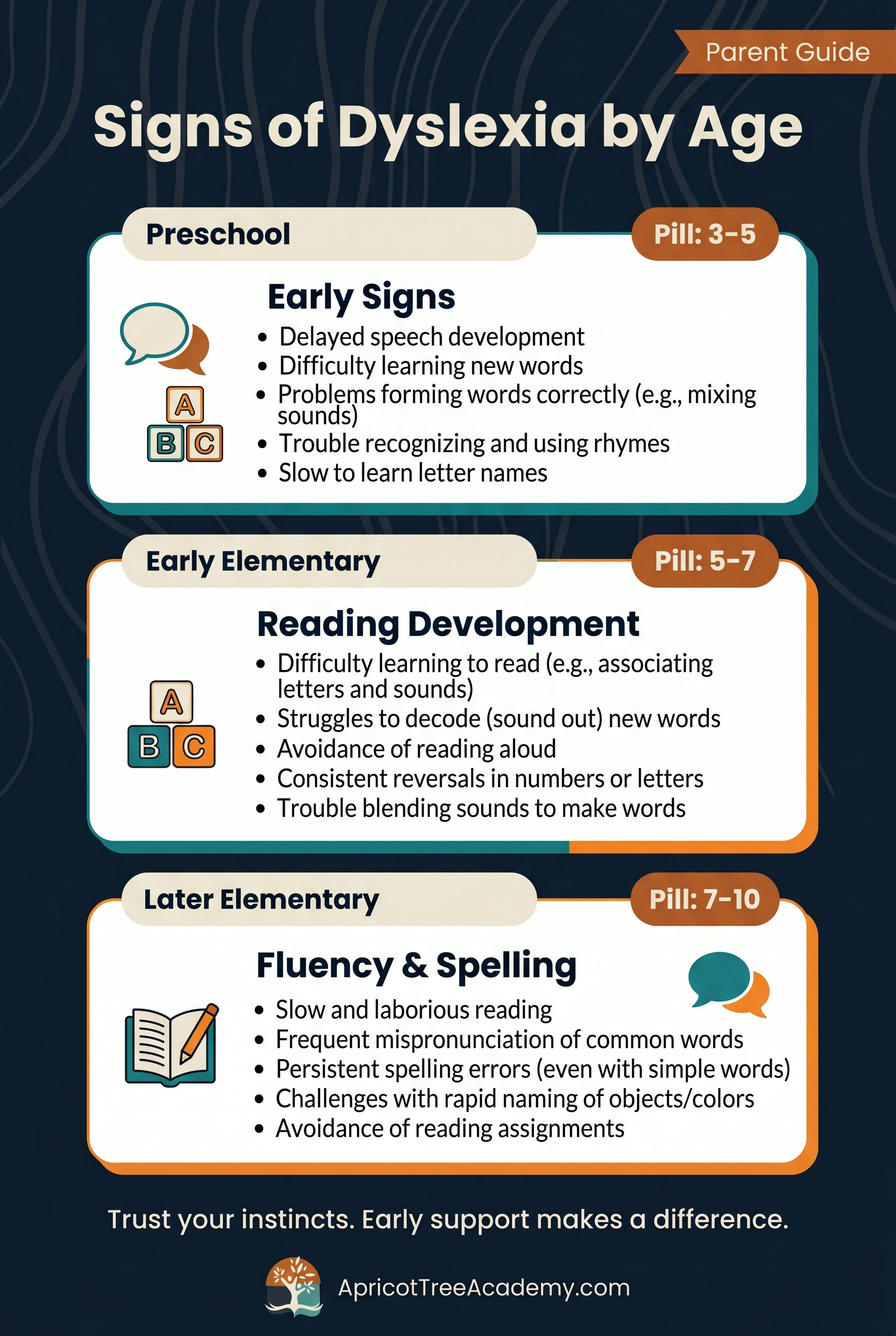
Below is what to watch for at each age band. None of these signs in isolation means dyslexia. Clusters of signs across multiple categories are what matters.
Signs in ages 5–6 (kindergarten and 1st grade)
Phonological awareness
- Trouble rhyming, even after lots of nursery rhymes.
- Can't break words into syllables (e.g., can't tell you "butterfly" has three parts).
- Difficulty hearing the first sound in a word.
Letter and sound knowledge
- Slow to learn letter names — particularly the difference between letters and their sounds.
- Confuses visually similar letters (b/d, p/q) past the point most peers do.
- Doesn't connect that "ssss" is the sound of "S" even after repeated teaching.
Verbal and language signals
- Difficulty pronouncing multi-syllable words (e.g., "aminal" for "animal").
- Trouble finding the word they want; uses "thing" and "stuff" a lot.
- Family history of reading struggles, dyslexia, or "late readers."
Signs in ages 7–8 (2nd and 3rd grade)
Decoding and reading
- Guesses at words based on the first letter or the picture.
- Reads slowly and with visible effort.
- Skips short words ("a," "the," "is") or reads them as something else.
- Avoids reading aloud or reading at all.
Spelling
- Spells the same word multiple ways in the same piece of writing.
- Misses obvious vowels or reverses letters far past the point peers do.
- Has trouble with sight words even after repeated practice.
Writing
- Writing is much shorter than spoken explanation of the same idea.
- Avoids writing tasks or melts down at writing assignments.
- Handwriting is labored, slow, or hard to read.
Signs in ages 9–10 (4th grade)
This is the age band when many parents finally get a diagnosis — because school content shifts from "learning to read" to "reading to learn," and the gap becomes impossible to compensate for.
Reading and comprehension
- Reading is still slow and effortful; can't read silently for pleasure.
- Comprehends what's read aloud to them but struggles with what they read themselves.
- Avoids longer chapter books or non-fiction text.
Schoolwork
- Math word problems are much harder than the math itself.
- Trouble with new content vocabulary across subjects.
- Homework takes far longer than it should — often hours.
Emotional signals
- Says "I'm stupid" or "I hate reading."
- Stomach aches before school, especially on reading-heavy days.
- Compares themselves unfavorably to siblings or classmates.
Signs that aren't dyslexia
Some things look like dyslexia but usually aren't. Knowing the difference saves you time and money.
- Reversing letters at age 5–6. Most kids reverse b/d and p/q in kindergarten. It's only a flag if it persists past mid-2nd grade.
- Slow start to reading. Some kids read at 7 instead of 5 and end up perfectly fluent. The flag isn't the late start — it's the absence of progress with quality instruction.
- Not loving reading. Disliking reading isn't dyslexia. Struggling to read despite effort is.
- Hating spelling tests. Most kids hate spelling tests. The flag is when your child can't retain spelling patterns across consecutive weeks despite practice.
When to request an evaluation
If you see three or more signs from at least two categories persisting beyond what's age-appropriate, request an evaluation. You don't need to wait for the school to suggest it — and you shouldn't.
- Email the school principal: "I'd like to request an evaluation for [child] for a specific learning disability, including dyslexia."
- Date the request. The 60-day timeline starts from there.
- In parallel, start a structured literacy program at home. Don't wait on the evaluation.
- If the school evaluation comes back negative but your concerns remain, consider a private evaluation by a psychologist who specializes in dyslexia.
Frequently Asked Questions
My child is in kindergarten — is it too early to test for dyslexia?
Formal dyslexia evaluations are most reliable from late kindergarten or early first grade onward. Earlier than that, you can still screen for pre-reading risk factors — phonological awareness, letter-sound knowledge, rapid naming — which are highly predictive. If those scores are low, start structured intervention immediately.
Does reversing letters mean my child has dyslexia?
Not by itself. Most young children reverse b/d and p/q. It only becomes a flag when reversals persist into 2nd or 3rd grade or appear alongside other reading struggles.
Can my child have dyslexia even with strong vocabulary and conversation skills?
Yes — that's the most common profile. Children with dyslexia often have above-average verbal ability, which is one of the reasons the diagnosis is missed for so long. The gap between spoken and written language is itself a signal.
Will my child outgrow it?
No. Dyslexia is a lifelong difference in how the brain processes written language. The right intervention closes the gap dramatically — but the underlying difference doesn't disappear.
Should I get a school evaluation or a private one?
Start with the school — it's free and triggers IEP/504 services. If the school evaluation is incomplete or inconclusive and you still have concerns, a private evaluation by a clinical psychologist or neuropsychologist with dyslexia expertise is worth the cost.